
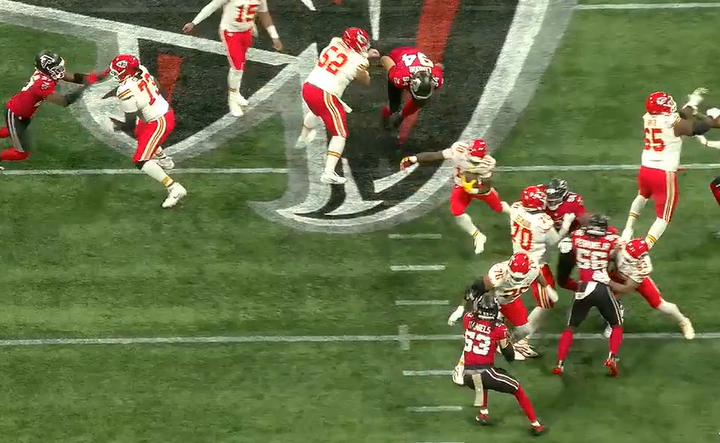

Matt Waldman shares his RSP’s pre-NFL Draft scouting report of Kansas City Chiefs RB Emmett Johnson, Waldman’s No. 2 prospect at the position last April.
RB Emmett Johnson’s RSP Scouting Profile
RSP Ranking: RB2
Jersey No. 21
Height/Weight: 5’10” / 202 School: Nebraska
Comparison Spectrum: Dalvin Cook – X/Devonta Freeman – Duke Johnson – Jordan James
Depth of Talent Score: 84.6 = Rotational Starter: Executes at a starter level in a role that plays to their strengths. Johnson is on the cusp of the Starter Tier: Starting immediately with large role and learning on the go.
Games Tracked (Opponent/Date/Link):
- Cincinnati ’25
- Michigan ‘25
- UCLA ‘25
- Penn State ‘25
- Iowa ‘25
The Elevator Pitch: Emmett Johnson’s pre-draft trajectory reminds me of Harold Fannin’s. They gained acclaim during the season based on their on-field performances.
There was legitimate excitement to see them perform at the NFL Combine. When they didn’t perform to expectations of the public, the excitement plummeted to the point that you could hear an echo out in the world if you broached their names.
Last year, I detailed how Fannin’s “bad NFL Combine” was an overstated and overrated analysis point. Fannin had a strong rookie year and could be taking over a lead role in the Browns’ passing game.
The gist of the analysis was about interpreting the tests, knowing how much weight to give them compared to other sources of information, and who else compared stylistically to Fannin in the NFL with similar production.
This year’s candidate for “The NFL Combine Threw a Red Herring into the Collective’s Draft Analysis” is Johnson.
Let’s begin with the 4.56-second, 40-Yard Dash. It’s the same time as Aaron Jones and they had similar dimensions at that point in their careers. The number is fast enough.
So is the 4.29-second, 20 Yard-Shuttle. A 4.30-second mark is the RSP’s minimum standard guideline for the Starter Tier. Both marks are in the Starter Tier, for whatever that’s worth when considering that the timing technology is either second- or third-tier technology with a high variation that makes it much less reliable than they want you to believe.
These were underwhelming marks for Johnson because the media and draft culture have been brainwashed to overvalue Relative Athletic Score percentiles. RAS is an entertaining and informative resource.
There’s value to knowing the percentile that an NFL Combine participant’s performance is relative to his peers. It unintentionally creates noise for the signal.
That signal is knowing what the minimum expected times should be for each position based on physical dimensions, style of movement, and expected role (elite starter, starter, rotational contributor, situational contributor, reserve, and free agent.
These factors provide valuable context well beyond RAS percentiles. When Johnson ran a 7.32-second, Three Cone Drill, the RAS Percentile Apostles of the Pseudo-Science Church of Oblong Money Ball that Bounces Too Funny for Predictability in Everything Baseball Does immediately cited the 32nd percentile like they were saying, “A-men,” from the pews of Lucas Oil Stadium.
Let’s dig deeper than the good book, shall we?
A Three-Cone Drill time commensurate with a starting RB in the RSP is seven seconds-flat or less. Here are backs who contributed at a high level with no better than Reserve Tier Three-Cone marks of 7.20 seconds.
- Kenneth Gainwell – 7.26 seconds
- Dalvin Cook – 7.27 seconds
- Samaje Perine – 7.25 seconds
- Jamaal Williams – 7.25 seconds
- Chris Carson – 7.53 seconds
- Devin Singletary – 7.32 seconds
These backs came in all shapes and sizes. Perine is a bulldozer with a straight-line game. When he changes direction, he’s working from a base that helps him work through contact. Chris Carson wasn’t as extreme in this respect, but there were similarities.
Devin Singletary and Kenneth Gainwell’s compensatory factor for their lackluster times is their mental processing of information at the line of scrimmage and speed of executing solutions that combine various tools that a lot of backs that possessed a lot more athletic ability can’t do. Both possess precise footwork – footwork that might not work for the Three Cone Drill, but it’s optimal for football.
Williams was a combination of both groups. He was a downhill banger, but he also processed the field well enough to be a step ahead in certain situations like short yardage and the redzone.
The player on this list that stands alone and was arguably the best of the group was Dalvin Cook. I was there when the SPARQ Denomination of the Percentile Apostles of the Pseudo-Science Church of Oblong Money Ball that Bounces Too Funny for Predictability in Everything Baseball Does were ready to doom Cook to football hell because of his Three Cone Drill and Vertical.
It wasn’t pretty. Here’s what I shared about Cook that they didn’t consider – if they did, they couldn’t do anything about because of the limits of the data collection method of the drills.
The three-cone drill approximates changes of direction we see from players performing lateral cuts. The correct assumption is that most running backs make lateral cuts when they change direction.
Dalvin Cook was an exception. Much of his change of direction was rooted in curvilinear movement – bending around an obstacle. The best at this skill can bend tight enough at a high rate of speed that it can be as effective as making cuts.
Cook didn’t even use lateral cuts as a runner. In some cases, his feet moved in place little pistons before he rotated in the direction he wanted to go. Watch for yourself on YouTube, and you’ll see it.
Cook’s curvilinear movement was a compensatory factor if you’re comparing it 1:1 to lateral cuts. Another perspective is that curvilinear movement is simply a style of movement that some players favor. Patrick Mahomes is a curvilinear runner when he breaks the pocket.
Because the general public and the Apostles of the Oblong Money Ball (I ain’t writing that mouthful again…) didn’t consider that their methodology for measuring performance can’t be one-size-fits all, Cook’s stock fell in the public eye. The Vikings knew enough to take Cook in the second round.
Cook had an eight-year career with a four-year peak with at least 1,300 yards from scrimmage. His best season was a 1,918-yard season from scrimmage with 17 touchdowns. These four peak years happened in consecutive fashion. They also happened after Cook tore his ACL during his rookie year.
In addition to everything else mentioned, the Three Cone Drill is not an everyday football drill. It’s one of the more difficult drills to perform with the technique to maximize the result, and only 13 percent of the Combine participants did it.
Johnson was the only RB to do it this year. The Three Cone Drill has the lowest participatory rate for a while now and it’s because it’s a skill unto itself rather than an exercise to mimic the true skill.
If a player does well, and it matches what I see on the field, I’ll cite it for two reasons:
- If they had to train for it, they went above and beyond to get the technique down.
- If they didn’t train for it and ran well, they are even quicker on the field than what the drill indicates.
If a player doesn’t do well, but it doesn’t match what he does on the field, I throw it out. If too much is made about this drill. I get to tell you why it’s a bullshit drill.
Unlike Cook, Emmett Johnson executes cuts with his game. Like Cook, he leans hard on curvilinear movement. Johnson also flips his hips efficiently to make 90-degree turns without the need of cutting. Like Devin Singletary, he processes information fast and can be a step ahead.
Repeatedly, Johnson identifies pre-snap tells from defenders and leverages it for quick cutbacks or bounces to open space. Post-snap, Johnson has precise feet to press deep enough into the line to work past a defensive push or penetration, buying time to assess and manipulate.
Johnson also runs a lot of gap plays. There’s not a lot of need for cutbacks, bounces, or reversals of field in this scheme. The back plays with pace and stride length if needed but otherwise, hits the crease hard and without hesitation.
Johnson isn’t just a gap runner. He’s experienced and skilled with Duo and varieties of Zone.
Johnson has precise footwork. His jump cuts may not be as electric as the altar boys confirmed by the Apostles of the Money Ball, but he gets his feet over contact and alters stride and pacing with his steps with precision.
I always think of Frank Gore when folks cite drills instead of footwork on tape. Gore, the age-cliff sinner with two ACL tears, befuddled the apostles when he was quicker, more precise, and more productive on the same plays and obstacles than their appointed bishop, Anthony McFarland. Last I heard, I heard the data papacy quietly transferred McFarland to the UFL branch.
Johnson is a good finisher who drags and pushes box defenders and wins collisions with linebackers and safeties in the open field.
His third-down game is NFL-ready as a pass-catcher on check-downs and leak routes. He has shown potential to develop an expanded route tree.
As a blocker, Johnson is capable working against linebackers and safeties even if there are details he can address that will make him more reliable. Those should come.
Johnson may never become a top-tier starter but at the very least, I believe he’s a high-end contributor who can become a good RB2 in a committee or a top-tier reserve who delivers high-end starter production when the franchise runner gets hurt early in the season.
That’s the worst case I can see for Johnson if he’s a healthy, well-behaved football player during his NFL career. The best case is that Johnson has a run as a lead back or starter that lasts 3-5 years.
Vision: Johnson identifies a linebacker potentially shooting the intended gap late pre-snap/early post-snap and gives a brief press of that gap before bouncing outside the linebacker and the end.
Johnson identifies a post-snap push into the backfield from interior linemen and presses that lane within a step of his blocker before cutting back
Johnson sets up his pullers on Counter and finds a cutback behind the backside puller when the defense has the front side edge covered with an unblocked defender and the front side puller is giving up an inside lane to the defensive line as Johnson approaches the designated crease.
Johnson can press within one step of a penetrating defensive tackle and jump cut outside to mitigate a loss or turn the loss into a short gain.
When there’s a clear crease or after a press of another crease, Johnson hits the intended rush lane without hesitation.
Johnson sets up his lead block and pullers on ISO or Power. When in the black zone, Johnson doesn’t attempt risky cutbacks, bounces, or reversals of field when the defense has hammed in a play design. Johnson takes what he can get within the structure of the play.
Whether it’s Zone, Duo, or Gap blocking, Johnson identifies penetration and works away from it to at least get the ball to the line of scrimmage. He also finds effective cutbacks on gap plays.
Johnson remains inbounds on perimeter plays at the cost of additional yardage, but to the benefit of running the clock out in the fourth quarter. He identifies safety blitzes before the snap of short-yardage runs. He’s prepared to leap away from the safety to get through the line.
When bouncing or cutting back a run from between the tackles, Johnson rides the wave – incrementally working to the outside with an additional press of a gap to draw the force player before working further outside.
There are some gap plays where Johnson could press deeper so the box defender doesn’t have time or space to redirect to the cutback or bounce lane.
Elusiveness: Johnson spins off hits from defensive backs in the open field. When transitioning downhill to the short-side edge of the line at the far hash coming from the near hash, Johnson needs 1-2 steps to bend downhill. Johnson uses a combination of stride variation and curvilinear bend to earn a tight turn downhill at a good rate of speed.
Johnson can jump-cut across the back of a blocker to access one gap over while in traffic. He kicks through low contact with the hip mobility and footwork to get his feet over reaches and wraps and then balance-touch out of the dynamic adjustment and continue his stride downhill.
Johnson delivers moves in succession to navigate tight creases and work past pursuit angles. He has a good pairing of pressure cuts to work between the tackles and avoid first- and second-level pursuit angles.
Johnson flips his hips effectively to make 90-degree changes of direction behind the line of scrimmage to avoid penetration and/or cutback/bounce a run to the next gap over or to the edge.
Johnson has an effective jump cut to transition downhill at the near-side flat and it only requires one step to get downhill and two defenders in pursuit from the inside-out.
After using curvilinear movement to bend around a linebacker at the second level as he clears a downhill crease, Johnson can get his feet and knees over the low shot of the pursuing defender.
Johnson has an effective double up and stick combination – a triple up (?) – that varies pacing and threatens the LB’s position without compromising Johnson’s balance and ability to change direction quickly.
Acceleration: Johnson has the burst to turn the short corner on linebackers and defensive ends. He can beat cornerbacks around the short-side edge when they are caught flat-footed or coming downhill at a different angle.
When Johnson is accelerating out of cuts, he doesn’t have the same explosion. This limits his opportunities for bigger runs between the tackles when other backs have the quickness out of cuts to avoid the same pursuit angles.
Speed: Johnson has the speed to reach the secondary and force a safety in the middle of the field to give chase for 35-40 yards before running Johnson down.
Power: Johnson pulls through reaches to his shoulders from linebackers. He pulls through multiple reaches when running between the tackles in the box that’s the first 5-7 yards around the line of scrimmage.
Johnson can pull through 2-3 reaches to his frame from linemen and linebackers during a run. He can also pull through a reach and bounce off a hit in succession.
Johnson uses a stiff arm to ward off reaches to his upper body when in dense traffic. His forearm shiver has the power to knock a safety to the ground
Once wrapped high, Johnson keeps his feet moving and can earn 2-3 yards after the contact without the help of teammates. When he gets help from his line, Johnson can keep his feet and be a part of pushing the pile 6-8 yards down the field.
Direct Contact Balance: Johnson can bounce off a hit to his chest from a cornerback and spin inside for an extra 2- 3 yards. He stalemates linebackers when hit hard in the back as he catches a target facing the quarterback. He also stalemates them in the hole head-on when he has downhill momentum into the collision. He can keep his feet moving and generate a push forward if a second defender doesn’t follow up immediately, or he can spin off the hit and get additional yardage.
Indirect Contact Balance: Johnson bounces off a cornerback’s hit to his side while pulling one of Johnson’s legs off the ground and still earns 2-3 yards with a spin off the contact. Johnson bounces off a glancing hit to his pads from a safety as he’s regaining balance from a difficult obstacle a few steps before. He delivers his forearm into the chest of safeties and takes them to the ground with the strike.
Johnson can bounce off a glancing hit to his pads and chest from a defensive tackle as he enters the crease. He’ll keep his feet and push forward with the help of his teammates. He can knock a defensive end backward when the end is leaning into the collision. Johnson will knock a linebacker to the ground with his pads at the entrance of a hole with a well-timed strike. He can also withstand a hard hit to his waist and thighs from a linebacker over the middle and continue forward.
Routes: Johnson has a quick stick at the top of a shallow out and follows with a flat drive step, but the line step is rounded off.
Johnson identifies the second-level defenders, works to depth, and settles into the open area, creating a friendly target for the quarterback. When crossing between zone defenders during his break, Johnson paces the tempo of the break and doesn’t show his eyes to the quarterback until he has passed the buzz/rollover defender.
When detached from the formation, Johnson sinks into his stance to begin his release and comes off the line without wasted motion, rolling off his front foot.
Johnson works with his quarterback with the first break doesn’t earn a target and the QB begins to break the pocket. He maintains a friendly target for the QB.
Receiving: Johnson uses his hands to catch targets close to his back shoulder. He can angle back to the QB while running downhill and use overhand attack. When extending away from his frame toward the ball and on the move, Johnson has lapses where his hands are too wide and it leads to clap-attacks. He has juggled and/or dropped the ball in these circumstances.
Johnson can extend for a high point away from his frame with tight hands and catch the ball without incident. He also catches and pierces off the high point and can make the first man miss despite the defender shooting for Johnson’s legs.
Johnson can take a hard hit and wrap to his back from a middle linebacker after extending for the ball away from his numbers with overhand attack. Johnson earns one-handed extensions for the ball away from his frame on outbreaking routes leading him into contact to his chest from a linebacker.
Johnson can also embrace the fall when he extends one-handed for a target away from his frame.
Johnson obeys the trajectory of the ball, turning through the catch point to set up a catch and pierce before he secures the target.
Johnson turns behind the break path of a target and catches with overhand attack at his back hip. He can turn through the catch and into an LB’s hit and remain on his feet, although the hit stalemated him and the linebacker.
Johnson extends low with his arms away from his frame to pluck low targets below his knees. He has lapses with targets at shoulder- or helmet-height where he leaves his feet unnecessarily.
He tracks over his shoulder against tight coverage with underhand attack at the boundary with late hands and gets both feet inbounds.
Blocking: Johnson chip-releases against defensive ends, delivering his shoulder into the outside shoulder of a defensive end. He collides hard enough to make the contact substantial, but he doesn’t overdo it to the point of forcing the linemen off the block of the tackle.
When facing linebackers outside right tackle, Johnson earns good depth at the edge of the pocket with a squat and square stance. He earns a chest-to-chest position and keeps his arms bent at the elbows while working under the arms of the opponent.
Johnson must work on a punch and getting his hands tighter so he can strike the chest with the first hit and control the interaction. Until then, Johnson is reacting to the defender’s chain of moves because the defender earns the first contact.
Johnson is a patient blocker with Most Dangerous Man assignments, working to the safety in the second or third level as a lead blocker. He shuffles his steps to shorten his stride and allows the defender to come to him after Johnson initially closes the gap.
Johnson earns a chest-to-chest position and uppercuts to the sides of the defender, under the defender’s arms. As with other blocks, Johnson must tighten his hands as a puncher.
Johnson identifies B-Gap pressure from a linebacker, earns depth into the pocket, and slides inside-out to get his pads on the inside shoulder of the defender, driving the blitzer outside. The closest thing he does to a punch is overextend with his shoulder into the defender’s chest. This reduces the push backward that the defender generates, but if Johnson struck first and with better form, he’d have a better shot of controlling the interaction. He gets pushed back into the pocket with his methods and the QB is under pressure.
Johnson picks up LB twists at the edge of the formation and slides into a square position with depth into the line. He overextends, leading with his outside shoulder. Defenders get the first strike, push Johnson backwards and even if Johnson recovers and delivers a second strike, he has given up ground in the pocket to the QB.
Johnson delivers effective strikes and follow ups on defensive ends when part of a double team at the edge. He also times his pads into safety blitzes through interior gaps.
Johnson picks up Green Dawg linebackers late in a pass play.
Ball Security: Johnson carries the ball high to his chest and uses his boundary-side arm. He can take rips and reaches to his ball-carrying arm. There’s some swing with his arm when he’s carrying the ball in open space or using dynamic movement, and that leads to his elbow being slightly loose from his side.
Johnson switches the ball to his boundary-side arm when he reaches open space and bends the run away from the original path of the play design.
Johnson has 5 fumbles in 3 seasons at Nebraska over a span of 554 touches – 1 per 110.8 touches. Most of his fumbles – 3 in 159 touches — occurred in 2024. In 2025, Johnson had 1 fumble in 298 touches – by far, the largest workload of his college career.
Durability: No significant injuries during his college career.
Pre-NFL Draft Fantasy Advice: Johnson might be available in the third or fourth rounds of rookie drafts ahead of the NFL Draft – maybe even the fifth round if the Apostles of the Oblong Money Ball poisoned the well. After the NFL Draft, there might be a rebound in his ADP that goes as high as the second round.
The likely range is rounds 2-4, depending on the size of your rosters and round allotments. If I had to narrow it further, late second to mid-third.
Boiler/Film Room Material (Links to plays):
- Catch, footwork, hip mobility, balance-touch, and contact balance
- Opens hips to avoid interior penetration and pressure cut back to the inside for six
- Adjusts stride length, opens hips and jump cut from penetration and contact balance/push
- High points the screen, double up, stiff arm, boundary work, burst
- Shiftiness in traffic
- Tracks over shoulder for one catch; extends one-handed and embraces fall for second target
- Hip mobility, pulls through reaches, and determined downhill runner
- Tight press, bounce, and burst
- Double up and stick to bait LB at the end of the crease
- 2025 Highlights
Now entering its 22nd season, learn more about Matt Waldman’s RSP — the most in-depth analysis of offensive skill position players available (QB, RB, WR, and TE). Or if you already know the deal, go ahead and pre-order (you know you want to) the 2027 RSP at a discount for a limited time beginning FRIDAY 11.27.26 for $19.95.
Matt’s 2026 RSP Dynasty Rankings and Projections Package (begins in June) is available for $24.95
If you’re a fantasy GM interested in purchasing past publications for $9.95 each, the 2012-2024 RSPs also have a Post-Draft Add-on that’s included at no additional charge.
Best yet, proceeds from sales are set aside for a year-end donation to Darkness to Light to combat the sexual abuse of children.