
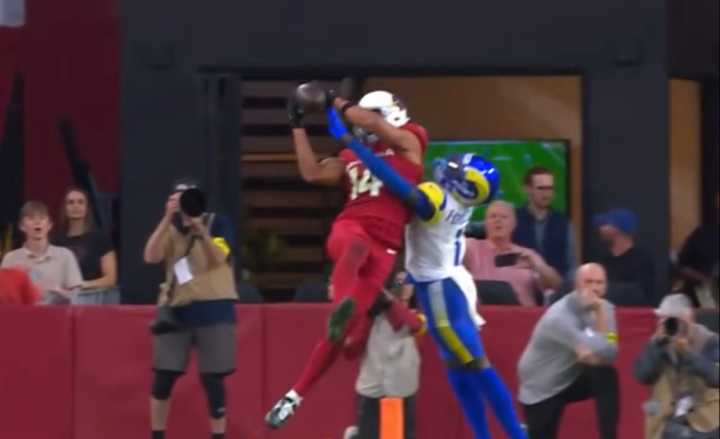

Matt Waldman shares his pre-NFL Draft scouting report of RSP Favorite, WR Michael Wilson.
My friend J.J. Zachariason likes to use the phrase, “never wrong, just early,” when it comes to trash-talking about his analysis. Although, “never wrong, just early,” is false — we’re all wrong, every year — it’s really about what you get right.
In this sense, the RSP can relate. Rico Dowdle and Michael Wilson are two good examples of the “never wrong, just early,” refrain.
If you’d like to get in early on players who make a difference, check out the 2026 Rookie Scouting Portfolio, available for download April 1 and taking pre-orders right now at a discount rate through December 22nd. After that, you pre-order at the regular low price.
WR Michael Wilson RSP Scouting Profile
Jersey: No. 4
RSP Ranking: WR10
Height/Weight: 6-2/213 School: Stanford
Player Comparison Spectrum: Michael Thomas-Michael Crabtree-JuJu Smith-Schuster-X
Depth of Talent Score: 84.1 = Rotational Starter: Executes at a starter level in a role playing to their strengths. Wilson is on the cups of the Starter Tier: Starting immediately with a large role and learning on the go.
Games Tracked (Opponent/Date/Link):

The Elevator Pitch: Michael Wilson and Michael Thomas have a lot in common:
- Body types: Wilson is an inch shorter and a pound heavier.
- Only .01 difference in their 40-Yard Dash (Advantage Thomas).
- Only .14 difference in their 20 Shuttle (Advantage Thomas).
- Only two inches difference with their Vertical Leap (Advantage Wilson).
- An excellent repertoire of release moves that are patient and sudden.
- Skilled route running.
- Short-area quickness and power after the catch.
- Foot injuries that required extensive rehab.
- Both are dedicated students of the game.
Wilson is stronger than Thomas as when Thomas entered the league. When you watch Wilson’s highlights or even his practice footage at the Senior Bowl, you’ll see a budding technician with the potential to dominate man-to-man coverage, especially from the slot.
Unfortunately, the one significant difference between Wilson and Thomas could be all the difference for Wilson’s career: His hands are not reliable.
Wilson has enough reps on film that showcase what he could be as a pass-catcher. He can make difficult adjustments high, low, wide of target, in tight coverage, and after contact. However, he doesn’t make them enough to project him with starter-caliber hands.
There are three details that he must address before that can happen:
- The position of his hands relative to the ball.
- Not attacking early enough with specific targets.
- Not earning optimal position with his body to address targets downfield against tight coverage.
If Wilson improves his techniques in these three areas—and it could happen by training camp—he could be one of the five-most promising receivers in this class. However, there’s no guarantee if or when this will happen and it creates a boom-bust factor with his evaluation.
Wilson is an organized learner and has communicated awareness of his flaws. Whether he’ll spot the key details and find the quickest and most effective path to address his issues is another matter, but being aware and taking his future job serious gives him a fighting chance.
Even with this massive boom-bust aspect lingering within his game, Wilson makes some excellent catches and he’s a short-are playmaker with the ball in his hands. Without the ball, Wilson is a physical blocker with a solid technical foundation to stalk block as well as work on the wing in the running game.
If his foot injury that required over a year of rehab isn’t a long-term concern, Wilson could become a top-15 producer at his position if he figures out his hands.
Where has the player improved? Wilson clap-attacks the ball less in 2022 than in 2021, but there are still lapses to correct with his form. He has improved his ball security.
Where is the player inconsistent? Winning targets against tight coverage and contact.
What is the best scheme fit? Stanford uses Wilson on either side of the formation and as the split end. Wilson is an outside coverage man on punt duty and displays skill with tracking the ball and keeping it in the field of play near the goal line.
What is his ceiling scenario? A high-volume slot-flanker with a role similar to Michael Thomas in New Orleans.
What is his floor scenario? A fourth or fifth receiver whose hands never become reliable enough to become a starter.
Physical: Wilson is a capable after-contact runner.
Technical: The biggest issue he has that could slow his progress is dropped passes. His selection of hand positions at specific target trajectories is suboptimal. In English, Wilson uses underhand position and allows the ball to get too tight to his frame in scenarios where attacking with overhand position is better.
Conceptual: He’s an excellent manipulator with his releases and route stems against man-to-man coverage.
Intuitive: His ability to manipulate defenders with releases and routes translates well to his work as a ball carrier.
Build: In addition to similar athletic metrics and style of running routes, Wilson has similar dimensions as Michael Thomas
Releases: Wilson has a staggered stance with 80/20 weight distribution favoring the front leg. He holds his hands above the knee but uncrossed and at either side of the front leg. He rocks off the back foot before rolling off the front foot. He needs to eliminate this wasted motion.
Wilson has a one-step stretch that needs a greater cultivation of patience and suddenness to bait the coverage. He works into the leverage of the cornerback and counters the opponent’s hands with a wipe. The wipe needs more violence.
Wilson’s double up has an effective contrast between patience and suddenness with the execution. He counters the defender hands with a shed. He can throw a sudden and violent shed.
He has a violent hesitation combined with a violent swat and swim. He also combines it with a wipe.
Wilson has an effective duck-walk (like two stutter moves in row) with a wipe counter. His two-quick is explosive enough to work and he’ll counter a defender’s hands with a wipe. So is the patience and suddenness with his hesitation and his stick.
He’ll also combine a three-quick, a hesitation, and a two-quick to drive a defender backward and outside as a setup for an inside break.
The stick can be especially violent and he sells the head fake. He’ll often combine the two-quick with the stick.
He’ll use the double up and shed to steal a release in the run game. His one-step stretch and swim is an effective move and counter to work past tight coverage playing outside shade against a slant.
Wilson also has an effective hip shift off the line to defeat man coverage.
When off the line of scrimmage and entering his stem, Wilson gets his pads over his knees, pumps his arms and digs in with a sprinter’s gate as he attacks downhill with his head and eyes up and facing downfield.
Separation: Wilson can beat the man coverage of a cornerback and earn 2-3 steps on the defender 15-20 yards downfield, maintaining that distance as the ball arrives. He stacks defenders when he has the earliest opportunity to do so.
Route Stems: Wilson will widen a stem off the line. He’ll sell the possibility of blocking the Most Dangerous Man assignment in the middle of the field while outside coverage his playing him man-to-man. Wilson slow-plays the stem and the changes up the speed to separate downhill.
Route Setups: Wilson will stair step a shallow route breaking outside. After widening the stem, he’ll bend it downhill to attack the leverage of the zone defender and then break it back outside.
Wilson understands how to peek at the top of his stem and lead the defender off track as a way of setting up a break in the opposite direction. He’ll also sell with a head fake to the inside.
Late in the stem on intermediate routes, Wilson will run at the toes of the defender who has turned his hips to run with the receiver.
He’s really sudden with his movements when transitioning from one phase of the route to the next, which adds emphasis to his manipulation tactics like pace changes, head movements, path alterations, and footwork.
He will take the back of the defender when it is given to him.
Route Breaks: Wilson snaps his head out of his breaks to look back to the quarterback immediately. He squares his frame to create a good target out of the break and runs away from the nearest defender.
Wilson can drop his weight and execute a one-long and three-quick break. The one-long break step needs to be longer and there needs to more weight drop. He has shown that he can deliver a three-quick with weight drop after accelerating to the top of the stem.
When delivering the one-long, he doesn’t fully accelerate into the top of the stem but he does accelerate prior to reaching the top of the break so he’s gaining confidence in executing this break at an optimal pace.
He has a tight drive step out of speed turns. On occasions where he has lapses, Wilson compensates with a flatter line step.
He sometimes angles his break steps which can lead to slipping.
Zone Routes: Wilson identifies the second-level defender, works to depth, and breaks across the zone at a tempo that maximizes his time in the open area. He also throttles down to the appropriate spot under the coverage with routes that have static breaks back to the quarterback. When the first break doesn’t come open or earn a target, Wilson will work to an open area.
Route Boundary: Wilson is aware of the boundary and will attempt to toe-tap inbounds, but he has to improve his tracking of targets arriving above his chest (see Pass Tracking).
Pass Tracking: Wilson tracks the ball over his shoulder with short out-breaking routes. He keeps his feet on the ground went catching targets above his chest when working over the middle or in a static position after the break. When breaking outside and the ball arrives above his chest, he will leap unnecessarily and it can cost him position to remain inside the boundary after contact arrives. He can track the ball over his shoulder with one hand against tight coverage.
Hands/Catch Radius: Wilson uses underhand position at the hips with his fingertips and arms away from his frame. He will squat to make a throw arriving blow his knees with underhand technique and his hands away from his frame. He’ll also extend away from his frame on the move and catch targets at shin level without losing balance.
He uses overhand position at chest and helmet level. He’ll also use it over his shoulder, tilting his shoulders back to the ball while running away from the quarterback.
Wilson can turn behind his break path and catch the ball on his back hip. Keeping his balance is another story.
Wilson has targets where he would should attack the ball at its earliest point but he’ll wait for the ball to arrive into is frame and use underhand position where he could have caught the ball with overhand position away from his frame. This limits his second-chance opportunities for the ball if something goes wrong.
His hands can also be too wide at the catch point or the hands angled with the palms facing each other too much rather than outward to the ball.
Position: When Wilson is in a position to deliver a jump through for an underthrown target to the back shoulder, he must turn his frame to address the ball rather than attempt to catch the ball at his back shoulder while his chest is facing downfield. If he executed the jump through so he could square the target and then turn through the catch to put his back to the coverage, it’s far more likely that Wilson earns the catch after contact.
Focus: Wilson can take contact to his back and maintain possession of a target at the catch point. He makes tight-coverage plays in the vertical game. There’s upside to his pass-catching but the technique flaws riddle every facet of his receiving game and must be addressed.
Transitions: Wilson obeys the ball and catches and pierces downhill based on the position of the target. He’ll even use a quick peak inside to set up the defender to turn outside and up the field.
Elusiveness: He uses stutters to freeze opponents and attempt to foil angles of pursuit. His two-quick stutter can freeze a cornerback in the flat and Wilson will run by the man.
He also only needs two quick steps to transition from a sideline track to a downhill track. He also possesses enough curvilinear movement with end-arounds and fly sweeps to get downhill through perimeter rushing lanes.
Wilson has an effective stick as a way of planting and opening his hip to cut 90 degrees to the boundary. He has an explosive spin in the open field or in traffic.
He does a good job varying the width of his steps and moves with long and short footwork to manipulate pursuit.
He’ll use post up maneuvers of peeking in one direction to set up a turn in the opposite direction.
Vision: He finds downhill creases and hits them with conviction. He’s patient in the open field and understands his speed relative to his teammates, knowing to wait until he draws pursuit close and then cuts behind them, turning them around to create more space.
Power: He’ll pull through reaches and wraps in the open field. Wilson gets his knees high enough to pull through wraps to his lower legs. He has a stiff-arm that wards off contact.
Wilson has effective body lean with his pad level when wrapped so he can fall forward
Direct Contact Balance He can drop the shoulder and drive his legs to push through a direct hit to his torso from a defensive back.
Indirect Contact Balance: When he drops his pads, he can bounce off indirect contact from a defensive back. He also bounces off this type of contact to his lower legs.
Blocking: Wilson is an effective blocker on Most Dangerous Man assignments. He works inside an earns an angle to cut off the pursuit lane of a linebacker or safety.
Wilson’s frame and effort are big enough to handle smaller outside linebackers, sealing them to the edge on running plays. He squares his frame to the assignment, breaks down with good bend of the knees and hips, and shuffles his feet to refine his position. He’ll get flat leads when working inside to seal box defenders.
When within range, Wilson shoots his hands, aiming for the opponent’s chest with tight position. He moves his feet after making contact.
Wilson will set up his position with Man Over Me assignments effectively. He’s good at working inside or outside to set up his leverage on the approaching defender and then tilt into the man, establish contact, and move the opponent with good footwork and hand position.
When playing in-line on the wing, he earns a tight position to his assignment. He must cultivate this more often with other assignment types.
Ball Security: Wilson carries the ball under his boundary arm high to his chest and secures it to the boundary arm immediately after the catch. The elbow is loose from his frame and the ball can drift a little lower than his chest but he’s conscientious about maintaining that height and corrects that drift quickly. He has improved his ball security from 2021 but a well-timed punch from behind with the looseness of the elbow can lead to lost fumbles.
Durability: Missed significant time from December of 2021 through early October of 2022 due to an undisclosed injury. Foot injury.
Pre-NFL Draft Fantasy Advice: I love what I see with his routes and releases and I’m optimistic that he will address his hands. That’s my personal, risk-friendly view. Professionally speaking, I’m preaching cautious optimism and that means valuing Wilson as a Gabriel Davis type of prospect—not in style, but from the perspective of seeing him as a project who may need 2-3 years to show what his exact value will be and not expecting immediate or consistent performances from him. He’s a mid-draft value for fantasy GMs before the NFL Draft.
Boiler/Film Room Material (Links to plays):
Now entering its 21st season, learn more about Matt Waldman’s RSP — the most in-depth analysis of offensive skill position players available (QB, RB, WR, and TE). Or if you already know the deal, go ahead and pre-order (you know you want to) at at discount for a limited time through 12.22.25 for $19.95.
Matt’s 2026 RSP Dynasty Rankings and Projections Package (begins in June) is available for $24.95
If you’re a fantasy GM interested in purchasing past publications for $9.95 each, the 2012-2024 RSPs also have a Post-Draft Add-on that’s included at no additional charge.
Best yet, proceeds from sales are set aside for a year-end donation to Darkness to Light to combat the sexual abuse of children.