
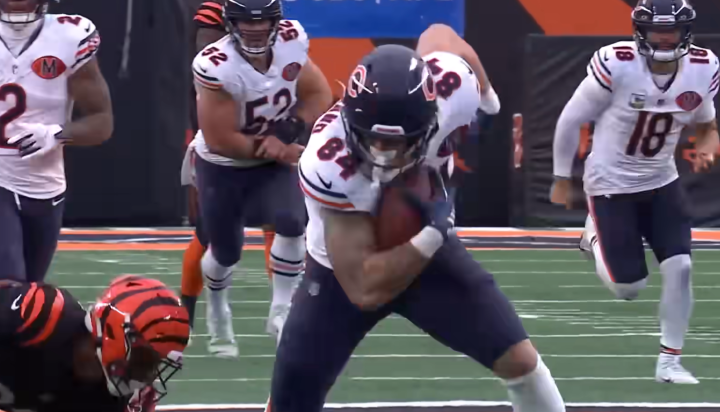

Matt Waldman shares his RSP’s pre-NFL Draft scouting report of Chicago Bears TE Colston Loveland, Waldman’s No. 1 prospect at the position last April.
TE Colston Loveland RSP Scouting Profile
RSP Ranking: TE1
Jersey: No. 18
Height/Weight: 6’5”/248 School: Michigan
Player Comparison Spectrum: George Kittle – T.J. Hockenson/Tyler Eifert/X
Depth of Talent Score: 88.8 = Starter: Starting immediately with large role and learning on the go.
Games Tracked

Elevator Pitch: Colston Loveland is real, but for a little while, we’re going mythical. Buckle up. It will all click into place. I swear…
Tight ends aren’t real. My co-host, Adam Harstad, and I discussed this point in 2022. We called them unicorns. We should have labeled them sport’s version of the chimera – a mythical fire-breathing female monster with a lion’s head, a goat’s body, and a dragon’s wings.
After all, a glass-eating fullback with the size, strength, agility, and technique of a small offensive tackle that can – oh by the way – run routes and operate in the open field like a running back, slot receiver, flanker, and split end is wildly imaginative. As dazzling as Rob Gronkowski was as football’s chimera for over a decade, the long-term demands are implausible.
Gronkowski played 11 seasons – 5 times, he missed at least a quarter of each season with injuries. He only played an entire season three times.
George Kittle arguably qualifies for mythical status at the position. Kittle has the skills to do it all. I’m not sure he meets the standard of application at the line of scrimmage demanded of Gronkowski. Kittle has missed 18 games in 8 years due to injury, only playing an entire season twice.
The demands of his hybrid role stretch the capabilities of the body too thin for most to perform. The fact we’ve seen two players in the past 15 years deliver a combined 6-8 seasons on this mythical scale is phenomenal.
The next tier down – where humans dwell – is where we find T.J. Hockenson. A capable blocker who isn’t asked to work on an island against front-side defensive ends with the regularity of Gronowski, Hockenson can also earn upwards of 85-95 receptions, 950 yards, and 6 scores.
Hockenson may not be the top weapon in his passing game but as one of the top three options in his offense, he can pace an offense in any given week.
Trey McBride’s recent production could be another potential career arc, but that will require a team to dial back the blocking requirements and amp up the receiving workload. It also requires a quarterback not fixated one option to the detriment of his offense.
As an aside, I hear that quarterbacks addicted to Call of Duty can experience low motivation, lack of productivity, poor relationships with others, or struggles with work performance. Last October, a gentleman even conducted a statistical analysis linking the Impact of Call of Duty Releases on Kyler Murray Quarterback Rating. The analyst acquitted Murray on the letter of the law but if this were a trial, he might not be sleeping well at night with that decision.
That brings us to Loveland. He’s one of two tight ends in this draft class with a remote chance of become the NFL’s next pair of chimeras, but don’t get your hopes up. Most likely, they’ll land in that next tier below with aspirations for a Hockenson role.
Loveland looks like a chimera on a college field. On any given Saturday in Ann Arbor, Loveland can be found winning dig routes against man coverage, earning chunks of yardage after the catch, sealing front-side defensive ends, and leaping over corners and safeties on back-shoulder fades.
Faster than a speeding bullet, more powerful than a locomotive, and leaps over tall buildings in a single bound? Sure, Loveland is a Big Ten Superman. So was Hockenson.
To become a true NFL chimera, we’ll need to see Loveland add Gronkowski weight and it’s unlikely we’ll see that transformation. While that may appear as a win for those wishing for the NFL to dial down Loveland’s blocking while amping up the receiving, his landing spot will matter.
Loveland may prove too good at the line of scrimmage to get roles on par with Travis Kelce, David Njoku, Sam LaPorta, or Mark Andrews. This is unlikely in today’s league that values receiving tight ends, but it’s possible and noteworthy.
More likely, we’ll see Loveland eventually earn a role as one of his team’s top-three receiving options. He’s a capable route runner who can stretch any part of the field against zone or man-to-man. He also does damage after the catch as an option who leaks into the open zone after assisting at the line of scrimmage.
Loveland is one of the best talents among the skill positions in this class. At the same time, one of those talents might anchor him to the line of scrimmage more often than Brock Bowers, whose game as a blocker isn’t as deep as Loveland’s.
Bowers is one of the most explosive athletes at the position that we’ve seen in a long time who can also perform receiving duties at the highest level. He’s one of one.
From a football standpoint, Loveland can have as much value as Bowers but expressed with greater versatility away from the box score.
Where has the player improved? Recognizing holes in zone coverage. Countering the hands of defensive lineman in the run game.
Where is the player inconsistent? Loveland doesn’t always approach linemen with a balanced stance from an inline position. He’s prone to overextending his frame and getting thrown aside early.
What is the best scheme fit? Loveland succeeded Erick All at Michigan, he’d be a nice fit for Cincinnati if All can’t make it back from his latest injury. Tyler Higbee hasn’t been able to stay healthy and outfitting Matthew Stafford with a Hockenson-like option in the Rams offense that will likely part company with Cooper Kupp.
What is his ceiling scenario? If Loveland lands on a team that wants to amp up his receiving usage with a Call of Duty addicted quarterback, he could rival Tre McBride’s peak production as a 100-catch/1,100-yard receiver.
What is his floor scenario? If a coaching staff values Loveland most as a run blocker and occasional play-action seam threat who gets the bulk of his receiving work leaking into the shallow zones, 70-80 catches and 700-900 yards may prove a more realistic ceiling.
Physical: Loveland holds up as a physical runner, winning collisions with defensive backs and off-ball linebackers. He’ll earn yards after contact. He gets his feet and knees high through contact, which also helps him break tackles.
Technical: Loveland can drop his weight into breaks. He must work on applying this skill to a greater variety of breaks so he maximizes the potential of his route running against man-to-man coverage and tighter zones that he’ll encounter in the NFL.
Conceptual: He doesn’t always aim for the correct shoulder when sealing a defender at the line of scrimmage.
Intuitive: Loveland is good at using his eyes and body language to community with his quarterback when working off-script.
Build: Loveland is currently in that Kittle-Hockenson range of dimensions and will likely remain there.
Releases: Loveland has a staggered stance when detached from the line of scrimmage. His weight distribution is 80/20 favoring his front foot. His hands rest at the top of his knee.
Loveland sinks into his stance and rocks off his back foot before rolling off his front foot with his pads over his knees. He has reps where he doesn’t waste motion when coming off the line of scrimmage. He sells the vertical with his stem effectively.
Loveland reduces his shoulder from inside shade that he attacks during his release. He has an effective read step, double up or two quick against outside leverage. He has an effective diamond release with a read step and two-quick combo with a wipe counter.
He counters the hands of coverage with a wipe, shed, or swat.
Separation: Loveland has the acceleration and long speed to beat safeties up the seam and the length and athletic ability to win contested targets against most defensive backs in one-on-one scenarios on the perimeter.
Route Stems: Loveland will widen his stems to attack outside leverage.
Route Setups: Loveland uses his eyes to sell defenders at the top of stems. He has an effective peek to sell the fade or out before continuing up the boundary.
Route Breaks: On shallow speed turns, Loveland has a long break step, flat drive step, and flat line step. He gets his head around early during the break, runs out the break, and finishes with a friendly position to the quarterback.
Loveland has a drop and pop break but the weight drop can be deeper so there’s sudden deceleration. He has a long break step into the deceleration phase, but not sudden enough deceleration.
Loveland earns a small amount of weight drop into whip routes but the route needs more bend. He is smooth in and out of the break.
Loveland can snap his turns on breaks inside or outside. He punches the boundary arm to generate much of that suddenness with the turn.
Zone Routes: Loveland identifies the second-level defender, works to depth, and settles into the open area. when working a vertical zone, Loveland tempos his breaks and doesn’t show his eyes until he has cleared the buzz/rollover defender. Loveland has some snap with his turns back to the quarterback. He can cultivate this more with the punch of his boundary-side arm.
If his first break doesn’t earn a target, he’ll work to an open area. he does a good job using his eyes to communicate with a quarterback off-script.
Route Boundary: Loveland is aware of the boundary, but when high-pointing he can have trouble getting one foot in bounds. He can toe-tap both feet in bounds with corner routes thrown above his head.
Pass Tracking: Loveland extends over his head for the ball without leaving his feet. He tracks short vertical targets over his shoulder. He can also extend behind his break over his back shoulder for a target without leaving his feet where he might have been better off turning back to the target and continuing the turn inside to get downhill.
Hands/Catch Radius: Loveland highpoints targets with good position/control of his frame. He catches targets at his back hip with underhand attack and turns against his break path to make the play.
Loveland also attacks the ball away from his frame and will extend his upper body beyond his legs and hips to earn the ball.
Loveland has lapses where he clap attacks targets with underhand position at his back hip and drops the target.
He attacks the ball at the earliest point of arrival when the ball is arriving near his frame and he’s in a static position facing the ball.
Position: Loveland can high point over a defender’s back, execute a pull-down away from an oncoming defender and take a hit to his back.
Focus: Loveland can take contact to his back or chest. He wins targets against tight coverage.
Transitions: Loveland catches and pierces downhill. With some throws arriving behind his break path, he’ll obey the ball and transition as he’s making the catch.
Elusiveness: Loveland can get his knees high and feet over low shots in the open field. He sticks his foot in the ground against backside pursuit and reverses field to shake them. While wrapped, Loveland can spin away from contact coming across the field to deliver a hit.
Vision: Loveland runs to open space, whether it’s against a single pursuer or working through traffic with blockers. He’s patient with setting up blocks and he’s skilled and splitting blocks. He can create with or without blockers and he’s wise about risks as a decision-maker.
Power: Loveland has an effective stiff-arm to ward off reaches to his torso. He can drag defenders wrapped around him.
Direct Contact Balance: Loveland wins collisions with safeties with downhill runways into collisions with his pads.
Indirect Contact Balance: Loveland bounces off glancing shots from linebackers and safeties hitting his thighs and hips. He has an effective balance-touch that helps him earn additional yardage.
Ball Security: Loveland has lapses where he doesn’t secure the ball immediately to his chest. Instead, he holds the ball with both hands like a pitchman in an option scheme. Loveland has fumbled the ball without any forced error because he failed to secure the ball early. When he has the ball secure, he can take a hit to his ball-carrying arm from a defensive tackle coming down the line.
Blocking: From an inline stance, Loveland comes off low, but overextends into the defensive end and gets thrown aside because he’s off-balance. When Loveland doesn’t overextend, he can counter the hands of his opponent and work his hands into the frame of the defensive end. This is something he’s good at doing and it leads to a stalemate between the two opponents because Loveland has a wide and balanced stance.
When pinning a defensive end inside on a perimeter run to his side, Loveland eliminates the gap between himself and the defender’s pads. His hand placement is effective and he can anchor his position when the defender’s hips aren’t square to Loveland’s.
When execute wind back or lead blocks to the opposite edge, Loveland’s aiming point should be the inside shoulder but he has taken the outside shoulder and lost the interaction early. When he takes the inside shoulder, his ballcarrier benefits.
Loveland can combo block with a double-team to the defensive end and peel to the linebacker downhill. He can strike the linebacker with an uppercut punch and roll through his hips.
Durability: Missed Week 4 in 2024 with a shoulder injury and then missed additional games after injuring his shoulder against Northwestern in the first half. He had labrum repair and AC joint reconstruction and should be ready for full participation in late July.
Pre-NFL Draft Fantasy Advice: If you’re seeking the next Brock Bowers, stop, turn around, and go home. The comps to Bowers are for SEO and product sales, or for those who don’t see the differences in athletic ability. Bowers has the athletic prowess to become a perennial top-three option at the position and have Travis Kelce-like peaks that equate to top-10 fantasy WR production.
Think more along the lines of Loveland as a potential Hockenson-like option who can give you top-five fantasy production in a peak year once or twice during their career – value that might equate to top-15 or top-20 fantasy value among WRs – but more likely a solid top-12 tight end in the range of 700-900 yards and 5-7 scores.
Loveland is a first-round value in 1.5 PPR scoring formats for tight ends. In standard PPR formats, Loveland would be a better value in the back half of the second round. In non-PPR formats, the back half of the third round.
Boiler/Film Room Material (Links to plays):
- Astute tracking, stiff arm, high knees/feet, contact balance
- Turning DE away from ballcarrier with good counter with hands and leverage
- Good speed turn, scramble drill, high-point vs contact, and good positioning post-catch
- Impressive mobility and tracking
- Colston Loveland Highlights
Now entering its 21st season, learn more about Matt Waldman’s RSP — the most in-depth analysis of offensive skill position players available (QB, RB, WR, and TE). Or if you already know the deal, go ahead and pre-order (you know you want to) at at discount for a limited time beginning FRIDAY 11.28.25 for $19.95.
Matt’s 2026 RSP Dynasty Rankings and Projections Package (begins in June) is available for $24.95
If you’re a fantasy GM interested in purchasing past publications for $9.95 each, the 2012-2024 RSPs also have a Post-Draft Add-on that’s included at no additional charge.
Best yet, proceeds from sales are set aside for a year-end donation to Darkness to Light to combat the sexual abuse of children.