
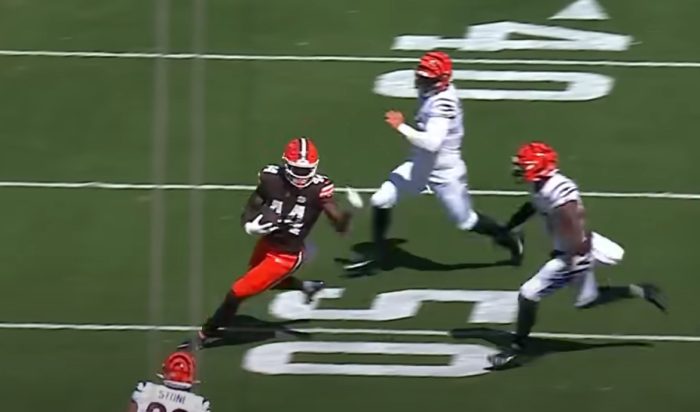

Harold Fannin Jr had a strong debut as a Cleveland Brown. Matt Waldman shares his pre-NFL Draft RSP Scouting Report on his No. 3 TE in this rich class.
TE Harold Fannin, Jr. RSP Scouting Profile
RSP Ranking: TE3
Jersey: No. 0
Height/Weight: 6’3”/241 School: Bowling-Green
Player Comparison Spectrum: Brock Bowers – Sam LaPorta – X/Delanie Walker – Garrett Graham
Depth of Talent Score: 83.3 = Rotational Starter: Executes at a starter level in a role playing to their strengths.
Games Tracked (Opponent/Date/Link):

Elevator Pitch: As previously mentioned, there is no second-coming of Brock Bowers in this tight end class. That said, Bowers is at the top end of the spectrum of playing style and athlete where Fannin resides.
Bowers is more mobile, often tops 21 MPH on the field, and is more refined as a route runner and blocker. Fannin has additional room for growth as a route runner and blocker, but he’s not as explosive – topping out at 20 MPH – and just a tier below Bowers as a mover.
None of that is bad, but developing into Bowers is a pipe dream for Fannin. A realistic aspiration might be Sam LaPorta.
The difference for Fannin’s draft prospects? An NFL team will make it a priority to create around Bowers to maximize his elite athletic ability.
There’s a little more variation of outcome for LaPorta types. Detroit new what LaPorta offered and adjusted their offense to exploit it. A long-time NFL scout and subscriber commented after reading my 2023 scouting report of LaPorta that I nailed the following assessment about NFL teams in regards to LaPorta types at the position:
What is his ceiling scenario? Seasons with 80-90 receptions, 900-1,100 yards, and 5-7 scores.
What is his floor scenario? LaPorta winds up on a team that wants to bulk him up and make him an in-line blocker because the coach and the GM are in a pissing contest and LaPorta rides the bench, plays special teams, or only sees cameo roles during the length of his first contract.
Our subscriber/former long-time scout explained that he’s seen a lot of tight ends fail because the coach fattened up a receiver to do an in-line tight end’s job just to prove a point to his front office.
This is the risk for Fannin, a former wide receiver and safety in high school, who was far and away, Bowling Green’s biggest offensive weapon. Fannin and LaPorta are both former wide receivers who transitioned to tight ends.
Pre-draft they are essentially the same height and weight. Fannin delivered a 4.39-second, 20-Yard Shuttle and 6.97-second, 3-Cone Drill.
LaPorta delivered a 4.25-second 20-Yard Shuttle and a 6.91-second, 3-Cone Drill. His vertical leap was 35 inches – one more than Fannin.
Based on how I group this workout data, LaPorta and Fannin are in the same tiers of performance for each drill mentioned above. The greatest difference is the 40-Yard Dash. LaPorta’s 4.59-second performance is 0.01 seconds inside the Elite Tier. Fannin’s 4.71-second performance is 0.01 seconds outside the Starter Tier.
It’s the 40-Yard Dash that shutdown a lot of the pre-draft love for Fannin among the public. Should it, though? When reviewing the routes Fannin ran at Bowling Green versus the routes LaPorta ran as a rookie in Detroit, the 40-Yard Dash results won’t matter much, if at all.
The highlighted routes are patterns where the difference in the 40 could have some impact. These are 7 out of 32 routes tracked.

Even if you make the argument that these seven routes may constitute a smaller percentage of work, but the gravity of the results have a large impact, let’s consider another measurement of speed into the equation – field tracking.
Fannin’s career max speed at Bowling Green is 20.3 MPH and his average top speed for his fastest moments were between 19-19.5 MPH. LaPorta’s career max speed at Iowa was 21.1 MPH and his average top speed for his fastest moments were 19.6-20 mph.
It’s a mistake to look at Fannin’s speed numbers and say they are bad because they don’t match up exactly with LaPorta’s. It’s correct to look at Fannin’s data and know that his on-field measured speed meets the standard for NFL starters at the position and his initial acceleration and change of direction exceed it.
You compare a player’s data to the baseline standards and you consider whether this data matches his style of play the demands that will be placed on him. Dalvin Cook’s metrics fell below baseline standards in certain areas, but Cooks’ curvilinear style of movement didn’t match the drills that measure how fast a player cuts.
Do you grade pastry chef on how well he cooks a steak just because they both work in a kitchen with many of the same tools? An NFL offense is a restaurant, what they choose to serve is up to them.
Although LaPorta’s vertical routes leading to huge games as a rookie will remain emblazoned in the minds of fantasy GMs for years, the success of LaPorta’s game doesn’t hinge on speed. Most of these vertical wins came on long-developing play-action routes against zone anyhow. Routes Fannin could have won in the same situation.
The final argument is what I’ll call the Isaiah Likely. Likely ran a 4.8-second, 40-Yard Dash. His 20-Shuttle time was 4.57 seconds and his 3-Cone Drill was 7.33 seconds. He leaped 36 inches with his vertical at 6’4”, 238 pounds.
Likely played at Coastal Carolina. Like Bowling Green, Coastal Carolina doesn’t have the training budget and facilities of a Big Ten program like Iowa. NFL teams understand this about players and if they see enough twitchiness from a small-school player, they know a year or two in an NFL weight room will make up for the difference.
The success of LaPorta – and Fannin’s – game hinges on short-area acceleration, change-of-direction-quickness, and precision. In this respect. Fannin’s physical resources offer more than enough for him to succeed in the same respects as LaPorta.
Fannin has a competent release game from the line of scrimmage. He understands how to be patient but sudden with his movements, and he’s quick enough to get opposing defenders on their heels at the beginning of a route.
This enhances his ability to dictate the action. As long as there’s enough explosion to dictate the action, the precision is what will carry the player to success with his routes.
Fannin understands how to manipulate man and zone coverage during his stems and both styles of breaks – speed turns and weight-drop – are good enough, right now.
Although I saw some drops and small technique lapses against tight coverage during one of my viewings of Fannin, these were minor lapses relative to the overall body of work I watched from three seasons at Bowling Green. Fannin has a good feel for tracking, attacking, and securing the football. As is the case with even the most technically sound NFL player, Fannin will have some lapses but they aren’t bad habits.
After the catch, Fannin has functional power and contact balance in the open field. He’ll bounce off hits in the secondary and work through tackle attempts, but he’s not speed/power mismatch.
What he is – and even more so than LaPorta – is a savvy mover who sets up defenders with excellent footwork and eliminates pursuit angles. He may not be a running back in open space, but his patience and creativity with pursuit angles is arguable the best of the tight ends in this class.
Like LaPorta, blocking isn’t Fannin’s calling card as an NFL prospect, but there’s still room for realistic growth with his game and he should develop into an effective situational blocker on the backside of formations, as a lead blocker, or double-teaming on the front side of plays.
A lot of this, Fannin can do right now. As a detached receiver, stalk blocks aren’t a problem.
The biggest question for Fannin will be the biggest question that faced tight ends like him—will the offensive fit be conducive for strong production? Based on the way the NFL is playing offense these days, there are two likely outcomes: 1) The team that drafts Fannin knows exactly what he is and how to use him. Or, 2) The team that drafts Fannin has more egos than Congress and the internal politics could kill Fannin’s potential.
Bet on Option No. 1 (but be prepared for the idiot factor of Option No. 2).
Where has the player improved? He has a wider and more balanced stance as a blocker.
Where is the player inconsistent? While I wouldn’t go so far as to say it’s inconsistent, there are isolated lapses with his attack away from his frame when handling contested targets.
What is the best scheme fit? An offense that uses two tight ends and likes to use an extensive play-action game that features throw-backs and other misdirection that allows quicker than fast receivers operating against underneath coverage an extra step to separate and earn good position for yardage after the catch. Offenses, that don’t lean on a big slot option at wide receiver and would prefer that option to be a tight end.
What is his ceiling scenario? A producer somewhere in the range of LaPorta and Delanie Walker capable of 800-1,100 yards and 6-8 scores during peak season.
What is his floor scenario? A cameo option similar Isaiah Likely in his current role with Baltimore where he can pace the team in any given week with his production, but won’t be counted on to do it weekly.
Physical: Fannin can bounce off glancing shots from linebackers. He’s sturdy enough as a runner to earn yardage on screens and in the secondary.
Technical: He can throw the ball 39 yards to the near-side boundary with catchable accuracy. Although it won’t be a weekly part of a team’s game plan, Fannin could earn some trick plays on offense and special teams.
Conceptual: Fannin has shown that he makes small and productive adjustments to catchable targets lacking pinpoint accuracy, including reaching behind his break path – and doing so against tight coverage or imminent contact.
Intuitive: When his first break doesn’t earn a target, Fannin will work to find open space for his quarterback. He uncovers quickly while maintaining a friendly target.
Build: Sam LaPorta/Delanie Walker archetype.
Releases: Fannin has a staggered stance with 80/20 weight distribution favoring his front foot. His arms hang at either side of his front leg.
When he begins his release, Fannin sinks into his stance and rolls off his front foot without wasted motion. He has lapses where he takes an unnecessary step with the front foot.
Fannin counters the hands of coverage with a wipe.
When aligned outside against tight man coverage, Fannin uses a feet-switch, a shoulder reduction counter, and then a lean-in to set up a break to the inside. He uses a double up to set up an inside release against off-coverage.
From a three-point stance, Fannin uses a read step to attack outside leverage and counters with a violent shed. He also counters with a wipe.
Fannin delivers a read step with a two-quick after it with a combination of patience and suddenness. His hip shift at the top of a stem on a sail route against off-coverage also has a patient but sudden quality. He also uses it well on fade routes as a boundary option.
Separation: He’s quick enough up the seam to challenge the intermediate zone coverage and earn open space.
Route Stems: Fannin widens stems to attack outside leverage. He’ll dive to attack inside leverage.
Route Setups: Against safeties playing over the top of the seam, Fannin delivers a hard head fake and stick to the inside at the top of his stems. He has an effective stair-step against off-coverage.
Route Breaks: When executing shallow out-breaking routes out of a break step, Fannin’s breaks are flat, but the drive step can be flatter. The line step is flat. He gets his head around quickly out of breaks.
Fannin uses a three-step break on stop routes. He also uses a three-step break with effective weight drop into a flat turn on a dig – including a flat line step.
Zone Routes: Fannin identifies the second-level defender, works to depth, and tempos his break between the zones. He waits to pass the buzz/rollover defender before showing his eyes to the quarterback.
Fannin settles into the open area and present a friendly target to the quarterback. He can snap his turns. He should do this more often. I only saw it once in four games that I charted.
When his first break doesn’t earn a target, Fannin will work to find open space for his quarterback. He uncovers quickly while maintaining a friendly target.
Route Boundary: Fannin is aware of the boundary and taps both feet inbounds on out-breaking routes.
Pass Tracking: Fannin tracks the ball over his shoulder with underhand attack up the intermediate seam. He can track over his shoulder with overhand attack on breaks to the shallow flat. He doesn’t leave his feet unnecessarily for targets arriving over his head.
When he must leave his feet, he can fully extend his arms and earn the ball while high pointing it over his shoulder in tight coverage.
Hands/Catch Radius: Fannin catches the ball over his shoulder with underhand attack. Even with a defender closing fast, Fannin extends his arms toward the defender and the ball and makes the catch away from his frame without distraction.
Fannin attacks the ball at its earliest point with overhand and underhand position. He high points effectively. When he has lapses with his hands, the ball is behind his break path and he has a small clap-attack with underhand position away from his frame.
Fannin has shown that he makes small and productive adjustments to catchable targets lacking pinpoint accuracy, including reaching behind his break path – and doing so against tight coverage or imminent contact.
Position: Fannin will jump up and through with an early high point to keep the ball away from the defender. He retracts the ball quickly to his frame from the high point so coverage can’t knock it free. He embraces the fall.
Focus: Fannin can track the ball over his shoulder up the intermediate seam with a safety closing on Fannin from the middle of the field and reaching for the ball. He can take a hit to his back from a trailing defender as he catches targets.
Transitions: Fannin catches and pierces downhill. He obeys the direction of the target to determine which way he catches and pierces.
Elusiveness: Fannin uses a stutter in the open field to freeze pursuit. He gets his feet over low shots.
Fannin only needs two steps to transition from a downhill runway at full speed to a path 45 degrees inside the pursuit over the top. He only needs two quick steps to transition downhill from a perimeter runway to the far-side edge.
He can then use two steps to bounce back outside the defender he turned around.
Fannin has an effective spin to transition downhill with no wasted movement. He can layer moves in the open field to set up defenders.
Fannin opens his hips efficiently to work away from pursuit in traffic. He has good curvilinear bend to work 90 degrees downhill to the opposite tackle with just one step. He weaves tighter turns outside and inside and sometimes in succession, executing at good speed.
Vision: Fannin is a decisive runner with a downhill mentality, who will use moves to create space or freeze defenders. If those moves don’t work, he takes the direct route to earn what he can get.
Fannin has the peripheral vision to spot backside pursuit from over 20 yards away and make a move to buy time against that defender and the defender over the top of him. He’s a patient and creative runner in open space.
He can press to his blockers’ side of the field to set up safeties over the top and then cutback.
Power: Fannin has an effective stiff arm to ward off a defender’s reach to his frame. He keeps his feet moving when a defender wraps his lower leg. He can drag a defensive back 3-4 yards after the compact.
Fannin can pull through wraps to his upper legs from defensive backs. He can pull through multiple reaches during a run.
He uses a forearm shiver to initiate contact with defensive backs and knock them backward. Although Fannin bounces off some hits, he’s not a pile mover unless he’s in the secondary and that may not prove the case in the NFL.
Direct Contact Balance: Fannin bounces off direct shots to his legs from safeties. He stalemates linebackers.
Indirect Contact Balance: Fannin has an effective balance-touch so he can at least extend toward the marker or goal line as a runner. He can bounce off a glancing shot to his frame from a linebacker with a downhill runway.
Ball Security: Fannin uses the boundary-side arm to carry the ball. He carries the ball high to his chest but with the elbow wide of his frame.
Fannin has lapses where he tucks the ball under his right arm even when catching targets outside the left hash and pursuit is working toward his right arm.
Fannin can take contact to the ball and/or ball-carrying arm in the open field and maintain possession.
Blocking: When double-teaming an edge defender with a left tackle, Fannin will be the aggressor. He gets his hands into the chest of the opponent, earns a wide stance, and when the defender redirects, Fannin turns into the side of the defender and pushes the defender in the direction the defender wants to go but past the path of the ball carrier.
Fannin can hook a force defender by attacking the outside shoulder and turning the defender around. As a lead blocker, Fannin will work into the crease and attack a linebacker or safety with a strike. He lacks a sound strike and because of his lack of size, Fannin loses the interaction early when the defender meets Fannin’s strike with a strike of his own.
When Fannin has a chance to peel off one assignment to deliver a hard strike with his pads to a defender in the area, he will.
As a pass protector against edge defender, Fannin can overextend when initiating contact. He moves his feet fast enough to make up ground on a defender redirecting off Fannin’s overextension.
As a stalk blocker, Fannin earns a tight position to the target, makes contact with underhand position, and moves his feet to seal the defender to a side.
Durability: No significant injuries.
Pre-NFL Draft Fantasy Advice: The amount of time I spent arguing in favor of Fannin’s athletic merits should tell you that Fannin is a candidate to surprise as an early NFL contributor with the right fit. He’s a better risk with dynasty drafts that occur after the NFL Draft. If you want tight end before the NFL Draft, consider the relative safety of Loveland, Taylor, Elijah Arroyo, or Tyler Warren.
Boiler/Film Room Material (Links to plays):
- Seam route into oncoming safety
- 39-yard throw with catchable accuracy
- Open-field footwork and vision
- Stair-steps route for TD
- Drops vs. tight coverage and clap drops
- Three impressive catches and tracking examples
- Harold Fannin, Jr. 2024 Highlights
Now entering its 20th season, learn more about Matt Waldman’s RSP — the most in-depth analysis of offensive skill position players available (QB, RB, WR, and TE). Or if you already know the deal, go ahead and pre-order (you know you want to) for $21.95.
Matt’s new RSP Dynasty Rankings and Two-Year Projections Package is available for $24.95
If you’re a fantasy GM interested in purchasing past publications for $9.95 each, the 2012-2024 RSPs also have a Post-Draft Add-on that’s included at no additional charge.
Best yet, proceeds from sales are set aside for a year-end donation to Darkness to Light to combat the sexual abuse of children.