
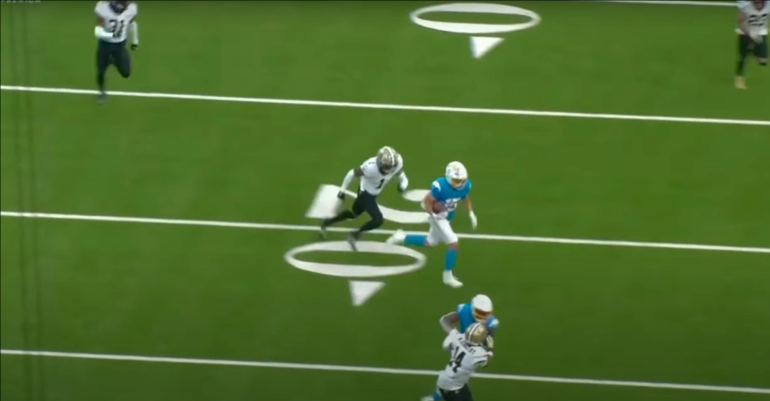

Matt Waldman shares his pre-NFL Draft scouting report (and pre-rookie year fantasy assessment) of LA Chargers WR Ladd McConkey.
For more RSP scouting reports – past and present – you can purchase the draft guides here.
WR Ladd McConkey RSP Scouting Profile
- RSP Pre-Draft Ranking: WR9
- RSP Post-Draft Ranking: WR4 and 5th on the RSP’s Post-Draft Rookie Cheat Sheet
- Preseason Fantasy Analysis: Potential top-10 receiver and lead option for Chargers (Free, and in great detail, at Footballguys)
- College Jersey: No.84
- Height/Weight: 5’11″/186
- School: Georgia
- Player Comparison Spectrum: Tyler Lockett – X – Kyle Phillips/Jeremy Kerley – Trent Taylor
- Depth of Talent Score: 88 = Starter: Starting immediately with a large role and learning on the go.
Games Tracked

The Elevator Pitch: This year’s Cinderella of draft media, McConkey has been billed as this year’s Cooper Kupp, but he’s more an aspiring slot version of Tyler Lockett without the proven contested-catch game along the vertical boundary that Lockett showed at Kansas State. McConkey has the speed to win in the vertical game but he hasn’t shown a contested catch arsenal along the boundary in terms of positioning his frame.
This wasn’t his role at Georgia so if he shows it, that’s a bonus. Until then, it’s best to use a “prove it” approach to evaluating what a player can do in this case.
McConkey has good footwork with his release packages. His hands aren’t as capable. He paws at defenders with his counters and lacks the violence and timing that’s necessary to win.
The strength of Kupp’s game, the player McConkey gets compared to frequently, was his expertise at using his hands and feet before and after the catch. Kupp’s selection of techniques to apply in a given situation was also better than McConkey who makes suboptimal choices with specific releases and gets hung up.
This isn’t a fatal flaw with McConkey’s game, but it currently makes him a less versatile and dangerous player than he should become with additional work. If he doesn’t develop in this area, it could limit his ceiling as a player who can do productive work on the outside.
His vertical game is at its best when he’s running double moves or working from the slot and making angled breaks to the intermediate or vertical boundary. Opponents learn quickly that McConkey has a good arsenal of breaks underneath coverage so they anticipate him earning separation under them when he’s baiting them with the possibility before accelerating past.
McConkey’s weight drop is deep and this not only earns him separation with routes breaking back to the quarterback or as the bait with double moves, but it also helps him make excellent stop-start moves to force pursuit to overrun their angles as a ballcarrier. This skill combined with his patience and expertise at setting up defenders into blockers and hugging those blocks makes him a strong runner in traffic and in the open field.
McConkey has a few minor details to clean up as a pass catcher so these non-fatal errors don’t add up and become a limiting factor for his game. He doesn’t use the optimal attack against coverage playing behind him and this can lead to drops when hit at the catch point. He also leaves his feet when the ball is on his numbers. This is often a tracking flaw where McConkey was not confident with seeing the trajectory of the ball and it can lead to using the suboptimal attack with his hands.
Overall, McConkey is a technically sound attacker of the ball in most target scenarios and can make plays against contact. He has the makings of a productive slot-flanker with some big-play potential in the play-action game and as a ballcarrier on RPO’s screens, and routes crossing zones.
That’s enough for him to have the Cooper Kupp role and earn those comparisons even if Kupp technically has a more complete game.
Where has the player improved? His speed breaks have more snap than in the past. He has also cultivated sharper drive and line steps so his breaks are flat right away and he can break back toward the ball.
Where is the player inconsistent? Tracking the ball on the numbers
What is the best scheme fit? A West Coast Offense where he can exist as a slot-flanker.
What is his ceiling scenario? A Kupp-like role.
What is his floor scenario? A plus-version of Kyle Phillips in an offense that doesn’t lean hard enough on the slot receiver in the passing game.
Physical: McConkey must cultivate more violence and precision with his hands during releases.
Technical: His weight drop is a big part of his route and ball-carrying. If he ever loses this skill, the effectiveness of his game will be cut in half.
Conceptual: McConkey has an excellent feel for setting up blockers and working off them. He understands how to stay tight to his blockers and this will help him get the most from schemed plays behind the line of scrimmage.
Intuitive: McConkey understands the combination of moves to truly sell a double move and knows which moves he performs that will make the route believable.
Build: Slightly below-average height and weight for an outside receiver and average height and weight for a slot.
Releases: McConkey has a staggered stance with 80/20 weight distribution favoring his front leg. His hands rest uncrossed at his front knee. When he begins his release, he sinks into his stance, rolls off his front foot without wasted motion, and cultivates a body lean with his pads over his knees and his head and eyes facing downfield.
McConkey will steal a release with a double-up or a double-up and shed counter, attacking the leverage with the double-up to the outside. He’ll also use a stutter-release.
He’ll reduce the shoulder against off-coverage 5-7 yards from the line of scrimmage or close to the line when running a shallow zone route.
He has a wipe at the top of stems on fades, but he is prone to pawing at the defender when he hasn’t closed the gap with the defender playing over the top of him.
He’ll also use a two-quick and wipe combination to work outside off-coverage playing 2-3 yards from the line of scrimmage. He can combine a feet switch with a two-quick to set up a short-breaking route against coverage playing a yard off him.
He also combines the two-quick with a swat-swim combo counter. He’ll also use the swat-swim at the top of a stem on an out-breaking route against off-coverage.
McConkey has a one-step-stretch to attack outside shade coverage tight at the line. He’ll also use a double-up in a similar situation after setting up the defender previously with the one-step-stretch/read step.
Another variation he uses on routes after the read-step and the double-up is the trigger step a few steps into his initial release from the line and then follow-up with a stick to the outside leverage of the defender playing 7-8 yards off. He’ll combine the double-up with a shed to attack inside leverage and work outside.
He’ll use a two-quick with a shoulder reduction. If hung up, he’ll swim through a turn to get rid of the defender.
He’ll attempt a hip shift and a wipe counter against off coverage playing outside shade while running a stem from the slot. A double-up might be a better move here. The hip shift doesn’t move the defender enough and the pattern isn’t ideal for the position of the defender relative to him.
Separation: McConkey can earn 3-5 steps of separation against a cornerback with his out-and-up double move. His acceleration is good enough to pull away from defenders in this open field after the catch.
Route Stems: McConkey will attack the defender’s feet—running at the defender playing 2-3 yards off him and then taking the back to set up a break back to the quarterback. He’ll also widen the stem against outside shade to set up the post.
Route Setups: McConkey will take the back of the defender during his stem to set up a break back to the quarterback. When running the out-and-up, he’ll drop his weight and turn his upper body outside with enough quickness to leave the cornerback flat-footed. This is one of his best vertical routes.
McConkey will use a peek to sell the outside break before dropping his weight and breaking inside against tight man coverage. He’ll also stair-step an in-breaking route against an off-coverage defender playing outside shade, attacking the leverage with a hard stick with a wipe counter and then using a second stick past the defender to break inside.
On fade or sail routes, McConkey will dive inside late in his stem against off-coverage.
Route Breaks: McConkey has a long break step and sharp drive step that can get him flat if he were to take an equally sharp line step on in-breaking routes. He gets his head around to the ball fast.
His line step is flat when executing a three-step break with the drop of his weight into an in-breaking route. He’ll also snap the turn and punch his boundary arm to do so. He accelerates well into his three-step breaks.
He has snap with his turn on a drop and pop break on intermediate routes. His speed breaks on intermediate out-breaking routes has improved. He earns flat drive and line steps, working back to the ball.
When McConkey’s initial break doesn’t earn a target, he will adjust fast to the open area.
Zone Routes: McConkey will identify the second-level defender, work to depth, and settle into the open area with a friendly position to the quarterback. He understands the coverage triangle for his routes and this helps him settle into the open area. When breaking across the middle, he will wait to face the quarterback until he passes the buzz defender.
Route Boundary: When facing tight coverage at his back on a sideline curl, McConkey can drag the feet to ensure he stays in bounds after the contact. He can also toe-tap his feet inbounds.
Pass Tracking: He’ll track the ball over his shoulder. He’ll also attack the target at its earliest point with overhand position. He leaves his feet on intermediate routes arriving at numbers height, using underhand position when defenders are behind him.
Hands/Catch Radius: He uses overhand position to catch targets arriving at number-height of his jersey. He’ll also use underhand attack at this height if it allows him to transition downhill as he’s making the catch away from coverage.
He’ll also attack the ball at its earliest point when settling underneath coverage in zone.
Position: McConkey tracks the ball well enough to come back to it late in a vertical route. He’ll embrace the fall when returning to the turf after going airborne.
Focus: McConkey can catch the sideline curl with a defender tight at his back and take a wrap as he secures the ball.
Transitions: McConkey will catch and pierce. He’ll also obey the ball and turn up-field based on the placement of the target.
Elusiveness: He’s quick enough to dip around a linebacker’s east-west pursuit angle as a runner in the open field or on a perimeter play.
McConkey has an excellent weight drop in the open field to come to a complete stop in two steps and force the pursuit to overrun him. His two-quick juke can make linebackers with position over the top of him miss.
He layers moves in succession to navigate traffic well.
Vision: McConkey patiently sets up a lead block on a perimeter run with an initial aiming point to the lead blocker’s inside shoulder and gradually works his way outside if the pursuit from the opposition calls for it.
He’s patient on screens, hugging his blocks until he gets even with the blocker and then accelerates into open space downhill or laterally based on the pursuit. He’s patient about allowing defenders within 1-2 steps of him before he dips away from their pursuit angle.
Power: He’ll use a stiff arm to slap down on the reach of a defender. He keeps his feet moving and body lean through wraps to his lower body.
McConkey can pull through reaches to his upper body and at least fall forward.
Direct Contact Balance: He can stalemate direct contact with a smaller linebacker.
Indirect Contact Balance: He can bounce off glancing shots from safeties and force them to slide down and wrap up.
Ball Security: McConkey uses the boundary-side arm and carries the ball high to his chest. The elbow is loose. He can take pulls to his arm and maintain possession.
Blocking: McConkey works within two yards of his opponent, drops his weight, earns a wide stance, and engages without overextending on stalk blocks. He runs his feet after making contact.
He can get low and bend his elbows and earn a chest-to-chest or chest-to-pads position early in the block. He must develop a punch so he can jar the opponent and control off that contact. Right now, he loses the advantage early because he’s not dictating terms. Too often, his arms to not bent enough at the elbows, if at all. He can get cast aside quickly when defenders—even cornerbacks—get under his arms and throw him to the side.
He takes the correct shoulder to seal the defender inside when the linebacker isn’t as tight to the line.
McConkey does the same thing with Man Over Me or Most Dangerous Man assignments.
He’ll peel off one block to the next once he gets help with the first.
He’s violent with his engagement of edge defenders when sealing the edge as a tight receiver on a perimeter run, but he can overextend in an attempt to compensate for his size and he doesn’t attack the outside shoulder, giving the defender leverage to shed where the runner is heading.
He also overextends as a stalk blocker when the opponent is arriving downhill at a pace quicker than him.
When he earns the appropriate position against linebackers on perimeter runs, he can turn the defender, taking the man where the opponent wants to go and running him outside the runner’s path.
Durability: Ankle Injury 2023 vs Ole Miss. Taped up during the game. Back injury earlier in the season.
Pre-NFL Draft Fantasy Advice: McConkey should find the right fit for his skills because he’ll have no worse than Day 2 NFL Draft capital. Within 1-2 years, he should develop into a productive receiver with no worse than a minimum of 60 catches, 800-900 yards, and 4-6 touchdowns. If he earns a Kupp-like role, he could see those figures increase to 80-90 catches, 1100-1200 yards, and 7-9 scores.
Boiler/Film Room Material (Links to plays):
Now entering its 20th season, learn more about Matt Waldman’s RSP — the most in-depth analysis of offensive skill position players available (QB, RB, WR, and TE). Or if you already know the deal, go ahead and pre-order (you know you want to) at an even greater discount than the normal steal of a price.
Matt’s new RSP Dynasty Rankings and Two-Year Projections Package is available for $24.95
If you’re a fantasy GM interested in purchasing past publications for $9.95 each, the 2012-2024 RSPs also have a Post-Draft Add-on that’s included at no additional charge.
Best yet, proceeds from sales are set aside for a year-end donation to Darkness to Light to combat the sexual abuse of children.