
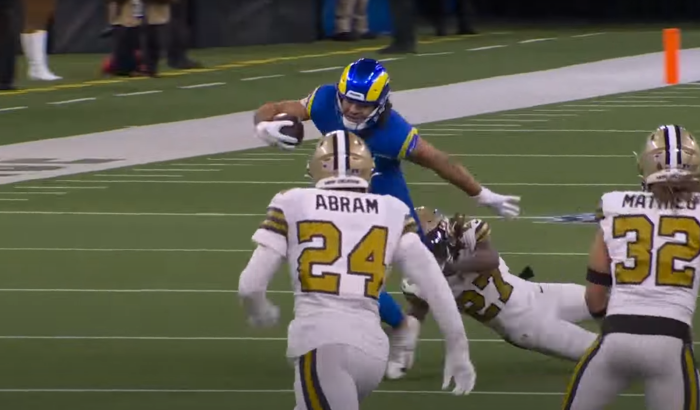

Matt Waldman shares his pre-NFL Draft scouting report and post-draft analysis of Rams’ WR Puka Nacua, a talent the RSP had as one of the most underrated options among the top 36 options available in rookie drafts.
Fantasy: Nacua Was One of My Most Underrated Values in May
I’m in no way telling you that I thought Nacua would be four yards shy (1,327) of Golden Tate’s career-best yardage mark (1,331) if comparing their best 16-game output. Tate was the player I shared as Nacua’s aspirational comparison — a slot receiver with flanker capabilities who, “in an offense with excellent passing-game talent, could have seasons with top-15 production if used as a high-volume target with flanker and slot roles.
No one I know predicted last spring or early summer that Nacua would do it immediately. I didn’t expect it. Still, Nacua was in my second-highest tier on my post-draft board as my 31st-ranked player out of 217 rookies and 1 of the 2 most underrated options in the first 2 tiers of the RSP Post-Draft Cheatsheet.
Every year for my RSP Pre-Draft/Post-Draft subscribers, I compare my post-draft rankings to the average draft position of several dynasty rookie drafts. Players taken earlier or later than +/- five spots from their ADP earn an overrated or underrated value. I also give the number of spots the player is over- or underrated.
The RSP’s analysis on Nacua had him “Under 14,” meaning I valued Nacua at pick 31 (round/pick 3.07 in a 12-team league) and that valuation was approximately 14 spots higher than where you probably needed to draft him. His average ADP was 4.09.
The purpose of this “Under 14” label is to tell dynasty GMs that I value Nacua more than a round higher than the average fantasy league and that you likely have as many as 14 spots after 3.07 (4.09) to take Nacua if you want to maximize your draft-day value. The closer you get to that 4.09 spot, the less likely he’d be available but that Under 14 label gives you wiggle room.
I follow my advice. I drafted Nacua at 4.06 in a league where I have an aging receiver room.
The Reality of the Pre-Draft Scouting Report: Worth the Initial Investment
That was my Overall assessment. See below.
WR Puka Nacua RSP Scouting Profile
RSP Ranking: WR19
Height/Weight: 6-1/201 School: BYU
Player Comparison Spectrum: Golden Tate – X – Early Doucet
Depth of Talent Score: 81.1 = Rotational Starter: Executes at a starter level in a role that plays to their strengths.
Games Tracked (Opponent/Date/Link):

The Elevator Pitch: Nacua is part of a large group of players in this receiver class who are in that zone of having enough skills and traits to potentially contribute and produce but need to refine 1-3 things to merit a recurring role with meaningful target volume. Nacua’s comparison spectrum is a perfect visual of this zone as well as his style of play.
Golden Tate had six seasons with at least 700 yards—three of them were 90-catch, 1,000-yard seasons (including a 1,331-yard campaign). He was a significant factor in an NFL passing game. Early Doucet only started 14 of 54 games in which he played and his best season was a 54-catch, 689-yard campaign with 5 scores.
Doucet was a weekly contributor and rotational starter. Tate was a more meaningful producer. Like Tate, Nacua has the potential to play inside and outside.
Nacua has a good start with his development of release combinations. He knows how to execute them with a mix of patience and suddenness.
He must add more manipulation techniques during his stems. He lacks consistency with the steps during the break to earn flat breaks.
Nacua is a skilled pass-catcher for the college level. He extends well for the ball away from his frame—high, low, and wide. He makes plays against tight coverage and maintains possession after contact.
However, he can be late to track the ball accurately when the target is over his shoulder and this leads to technique breakdowns that could hurt him more in the NFL where the margin for error is tighter. He also lacks confidence in tracking targets at his chest and above, which leads to unnecessary leaps for targets and trickles down to suboptimal hand positions.
If he doesn’t address these tracking issues—and they can be hard to address—he could wind up a reserve with situational playing time and never dig out of that role. If a team manages the issue by sticking Nacua in the slot in scenarios where his teammates go deep, he could still have a productive career even if he doesn’t address the tracking.
If he has a quick fix for tracking within a year of his tenure in the NFL, Nacua could have a consistently productive career where Doucet’s best season is his baseline production, at worst.
Once he makes the catch, Nacua is a skilled runner with good decision-making in traffic, skill to make the first man miss, and some tackle-breaking ability. He’s not yet an asset in the run game, but he should get there.
Overall, Nacua has enough promise to break through the ceiling of the rotational contributor tier to the rotational starter tier that he’s worth the investment to find out.
Where is the player inconsistent? His sequence of steps with speed breaks isn’t consistent from route to route. It leads to breaks that drift.
What is the best scheme fit? Nacua is a flanker, but there could be potential for him to also work the slot. He’d be an asset in a spread offense that finds him work in the slot and leverages his running with RPOs, bunch sets, screens, and jet sweeps. He also has potential as a flanker in a play-action offense that runs a lot of 11 or 12 personnel.
What is his ceiling scenario? In an offense with excellent passing-game talent, he could earn top-24 statistical production at his position. While he’s playing at peak health, he could have seasons with top-15 production if used as a high-volume target with flanker and slot roles.
What is his floor scenario? Nacua is limited to perimeter duty as a deep threat and a gadget extension of the running game and this either makes him a rotational contributor or a situational reserve. This will likely happen if the way he catches the ball doesn’t translate as well to the NFL as it did at BYU and he can’t address the situation before coaches label him.
Physical: Nacua has no issue mixing it up against tight coverage, traffic, or contact.
Technical: Nacua’s route breaks need refinement so he can achieve flat breaks with every route type he’ll likely run. His
Conceptual: Nacua must develop more techniques to manipulate defenders during his stems.
Intuitive: His pass tracking hasn’t hurt his charting sample much at all, but the demands on a receiver in the NFL are high enough that flaws like his tracking, hand and body positioning, and clap-attacking that he gets away with at BYU are less likely to work out on Sundays. He appears late with tracking targets accurately in the vertical game
Build: He’s a medium-sized receiver as a slot or flanker.
Releases: Nacua has a staggered stance with 80/20 weight distribution favoring his front leg. His arms rest uncrossed at either side of his front leg. He rolls off the front foot after generating some sink into his stance and his release has no wasted motion.
Nacua’s pads tilt over his knees with his head down but eyes up. His arms pump deep with a sprinter’s gait.
He has a two-quick footwork against off-man or the shallow zone defender. He’ll counter the defender’s hands with a double swat or a wipe if it’s at the break.
One of his better pairings is a one-step stretch with a double up to the inside. He counters his opponent’s hands with a wipe. He also pairs a hesitation with a two-quick on fade routes. He’ll also pair two hesitations with a swat.
His one-step stretch as a nice balance of patience and suddenness. He follows it up with a violent wipe. His foot-switch isn’t a routine part of his repertoire but he executes it with suddenness.
Nacua uses the wipe as his go-to but he also uses a shed and will do so against off coverage during his stem.
He has a quick-two paired with a shoulder reduction that lacks refined execution. His stick-and-wipe against off coverage can be sharper. The patience and suddenness with the stick and wipe against man-to-man is good. The violence of the wipe is also there. He pairs a swat-swim combination at the top of his stem.
His footwork and hands are sudden and he attacks the leverage of the defender.
Nacua will steal a release in the run game.
Separation: Nacua will stack a defender when he earns separation early in a vertical route. He can easily beat safeties matched up with him-even when they are playing 8-10 yards off. He’ll also get at least a step on cornerbacks, but Jarren Hall has a lot of underthrows on tape that mitigates that separation.
Route Stems: He’ll widen stems against outside shade when running a vertical route against off-coverage. He’ll dive stems inside against a triangle of zone defenders to set up shallower routes based on his alignment.
Route Setups: He’ll use a quick peek near the top of a vertical step against coverage playing outside and over him. When stealing releases and stalk blocking Nacua will take the back of the defender as a way to set up his position. This can translate to his route running with some conscientious effort.
Route Breaks: With speed breaks, Nacua has a sharp drive step but needs a sharper line step to generate a flat break on a regular basis. He’s better at the tight line step when the break is on a curl or stop route rather than a break running away from the defender over a longer area of space. This has been the case for the past two years of film.
He can punch the arm and generate a snap turn. He gets his head around but it’s an incremental movement from downfield to the boundary and then back to the quarterback. He has to look for the ball faster.
When his first break doesn’t earn a target, he’ll work with the quarterback to find an open spot.
Nacua has a three-quick break with hard breaks.
Zone Routes: He understands the zone triangle closest to his route assignment and works to depth against the second-level defender. He finds the soft spot and settles there. He’ll slide a step or two away from the defender if necessary to generate more space after the break.
Route Boundary: Nacua is aware of the boundary as a receiver and adjusts his stride or feet while airborne to toe-tap inbounds, even while taking contact. Nacua can tight-rope and drag his heels or toes along the boundary with targets where his back is to the sideline or if he’s fully extending his body over the boundary line.
Pass Tracking: Nacua will leave his feet unnecessarily with targets on routes that arrive at chest and helmet level. This is a habit and it can also induce a lapse of hand position where he uses overhand position but separates his hands late in the arrival portion of the target’s trajectory and he’s then forced to clap onto the ball, which generates the potential of him fighting the target.
Nacua tracks the ball over his shoulder against tight coverage at the boundary and can take the hit to his side and chest. He can do a better job of identifying and adjusting to targets over his shoulder that are outside the path that he took. He’s late to see the adjustment and it forces him to rush the adjustment and miss the ball.
I think he can be a little late with identifying how to adjust/attack the ball when he’s turning for a jump back or tracking the ball over his shoulder. It leads to suboptimal positions with his hands.
Hands/Catch Radius: He catches targets at the numbers with overhand position. He extends his body effectively to catch targets lower than his knees, but he doesn’t extend his hands. He allows the ball into his body.
When forced to extend wide of his frame for the ball, he can do so high or low as well as in front or behind his break path. He can also fully extend his body for the target.
He clapped a snap and fumbled it in the green zone against Stanford.
Position: Nacua will embrace the fall after dragging his feet at the boundary and taking a hard shot. He has improved with this technique since 2021 when there were reps of him landing on the ball. He has an effective jump back and pull-down against tight coverage.
Focus: Nacua can take a hit to his back while securing the ball at the breakpoint of a route. Although he leaves his feet unnecessarily and allows the ball into his frame, he can also take sandwich-style hits in the back and chest from defenders covering him and the area.
He has quick hand-eye coordination with a tipped target with a defender in tight quarters. He made the game-winner on a fade route against Boise State with this scenario.
Transitions: Nacua will catch and pierce downfield and obey the direction of the ball.
Elusiveness: Nacua has good stop-start quickness and he’ll sidestep pursuit tight to his frame coming from over the top. He flips his hips effectively to get skinny against angles of attack.
He can string moves together with his short-area quickness to make defenders miss and/or slip tackles. He has an effective spin to work through reaches to his frame or anticipate a pursuit angle and foil it. He has a sudden stick or first move to avoid pursuit.
He’ll use a shoulder dip or head fake in the open field to set up pursuit of a defender working outside-in. He’ll try to spin through wraps. He does it well when he can drop his weight into a quick stop. He has the balance to spin off hard hits from linebackers.
He has the curvilinear movement to bend around far-side edges in order to transition downhill from a perimeter path. He only needs two quick and small steps to transition downhill when pursuit cuts him off at the edge.
He’s effective and getting his feet high in order to avoid low shots.
Vision: He’s a patient runner against unblocked pursuit arriving over the top and has the movement to set them up and work around them. He’s also a patient runner with designed plays on the perimeter, understanding when to dip inside to set up pursuit and then bounce outside of it.
Power: Nacua has an effective stiff arm to ward off wraps and reaches. He can transition from a stiff-arm to a balance-touch when knocked off-balance. He uses his pads to engage with oncoming contact. He’ll keep his feet moving to finish runs when wrapped high by defensive backs.
Direct Contact Balance: He’ll bounce off downhill contact with a cornerback in the open field when he initiates the collision with his pads. He bounces off direct contact to his chest from a safety while airborne at the catch point.
Indirect Contact Balance: He will drop the pads and bounce off indirect contact to his upper body, forcing the defender to slide down his frame and wrap up. He can take a hard shot to his side and pads from a linebacker delivering it from backside pursuit. He bounces off defensive backs hitting his lower legs or chest.
Blocking: As a Man Over Me blocker, Nacua will close the gap tight enough to extend his arms into the chest of the opponent. He’ll break down and after contact, extend his frame low and forward in order to dig in tighter to the opponent’s frame and move his feet to drive the opponent backward.
He maintains a wide stance to anchor against contact.
Nacua locates his Most Dangerous Man assignments and works to depth so he can break down and square up the safety or linebacker.
Ball Security: Nacua carries the ball high to his chest. He uses the boundary-side arm based on the direction of a running play and how he’s handed the ball. He reflexively tucks the ball to his right arm even when targeted on the left side of the field. He can take contact to the ball when he has it tucked.
Durability: Foot injury at Washington in 2019. Broke his foot and missed 4-5 weeks. Missed a game after that with an undisclosed injury.
And of course, if you want to know about the rookies from this draft class, you will find the most in-depth analysis of offensive skill players available (QB, RB, WR, and TE), with the 2024 Rookie Scouting Portfolio for $21.95–currently available for $19.95 via early-bird discount that runs through December 21, 2023.
Matt’s new RSP Dynasty Rankings and Two-Year Projections Package is available for $24.95
If you’re a fantasy GM interested in purchasing past publications for $9.95 each, the 2012-2023 RSPs also have a Post-Draft Add-on that’s included at no additional charge.
Best yet, proceeds from sales are set aside for a year-end donation to Darkness to Light to combat the sexual abuse of children.